
Kaju Katli (Cashew Barfi) Without a Candy Thermometer
Thin, diamond-cut cashew fudge made with just cashews and sugar syrup, cooked to the classic one-string stage by eye and feel.
Kaju katli is made by grinding raw cashews to a fine powder, cooking sugar and water to one-string consistency (a drop pulled between two fingers forms a single unbroken thread), stirring in the cashew powder off the heat, and kneading the resulting dough while warm before rolling it thin and cutting it into diamonds. Getting the syrup to exactly one string — not underdone and syrupy, not overdone and turning to hard crystal — is what decides whether the barfi comes out soft and pliable or dry and crumbly.
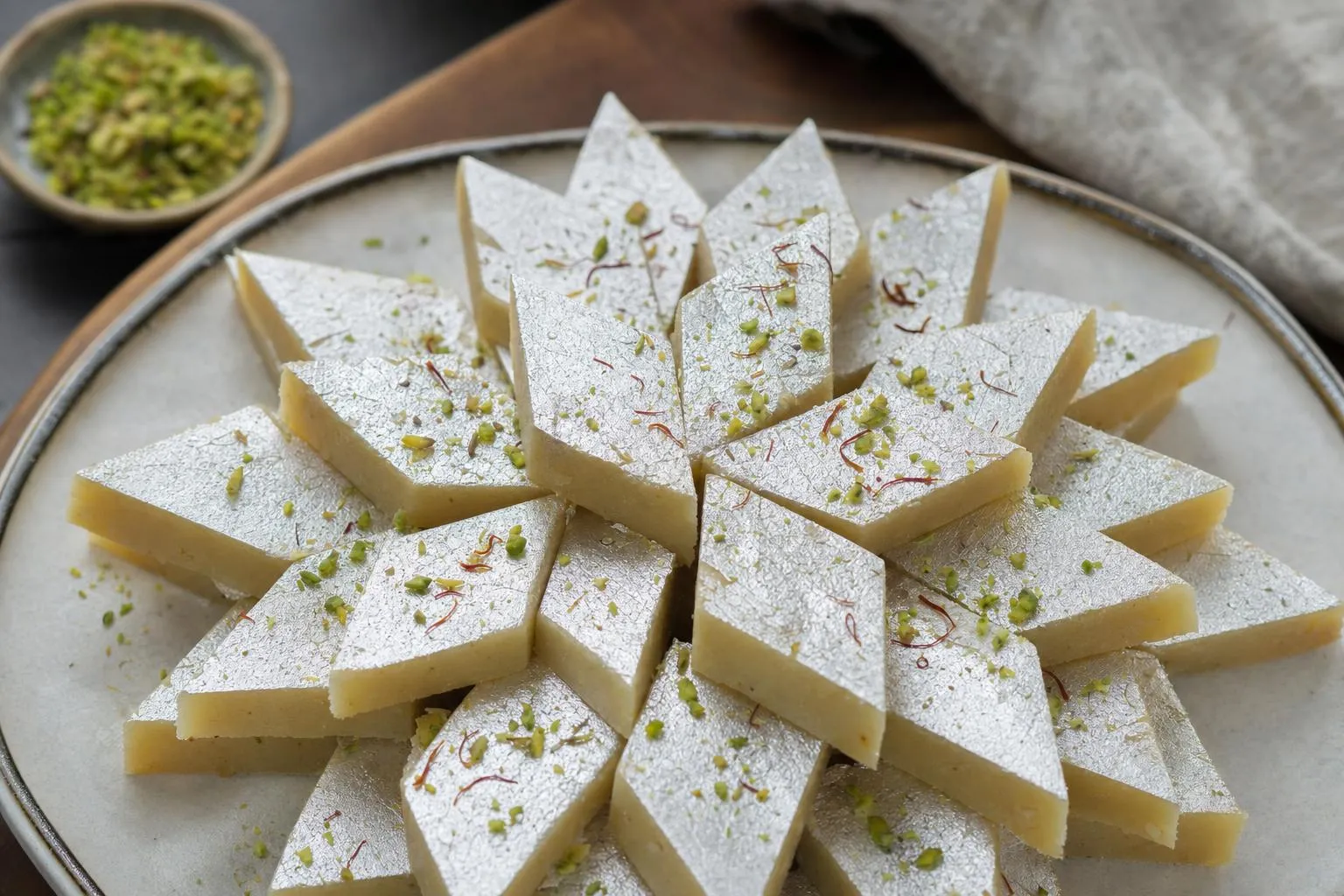
VegetarianNo wheat Contains no wheat. Nearly dairy-free — the only dairy is half a teaspoon of ghee for greasing, which coconut oil replaces, making it vegan. Cashews are the main ingredient.
Kaju katli is the barfi non-Indian friends ask about by name: thin, diamond-cut and silver-topped, on every Diwali plate and in every wedding sweet box. It contains no milk solids at all. No khoya, no chhena. Just cashews and sugar syrup, worked together until the fat in the nuts and the sugar bind into something you can roll out like dough.
Everything rests on one moment, and it is a moment you judge by hand. Nobody abroad is selling a candy thermometer calibrated for one-string syrup, so the test is the one Indian kitchens have used for generations.
How to tell the syrup is ready
- Start testing at four minutes. Lift a drop on a spoon, let it cool for a second, then press it between thumb and index finger and pull them slowly apart.
- One unbroken thread is the target. It should stretch roughly a centimetre before it snaps. Take a fresh drop for every test so you are not scalded checking the same one twice.
- No thread at all means not yet. Simmer for another 30-45 seconds and test again. This is the common case and the easy one to fix.
- Two threads, or amber creeping in at the pan edges, means you have gone past it. Start the syrup again rather than pushing on, because the barfi will set grainy and hard.
Have the rest of your setup ready before the syrup goes anywhere near the heat: greased parchment, a greased rolling pin, the ground cashews measured out. Once the powder goes in, the mixture keeps cooking on residual heat and firms up fast, and there is no pausing halfway through kneading to hunt for baking paper. If you would rather practise reading syrup on something forgiving before committing a bag of cashews to it, the syrup in gulab jamun tolerates a much wider margin. And besan ladoo covers similar ghee-sugar-nut territory with no syrup stage at all.
Kaju katli or kaju barfi?
The two names usually mean the same sweet. Kaju is cashew. Barfi is the whole family of dense Indian fudges, and the word is usually traced to the Persian for snow. Katli means a slice. So kaju katli is, quite literally, a cashew slice: one particular way of cutting a cashew barfi.
In practice the names follow the cut more than the recipe. Ask a sweet shop for kaju katli and you get the thin, silver-topped diamond. Ask for kaju barfi and you might get the same thing, or a thicker square, depending on the city and the shop. Neither is wrong.
The dough does not change. For the thicker kaju barfi, roll it to about 1/4 inch (6mm) instead of 1/8 inch and cut it into squares. It eats denser and more like fudge than the delicate katli slice. Leave it a little longer to firm before cutting, because the thicker slab takes longer to set through.
The one-string test
- Lift a drop on a spoon and let it cool a second.
- Press it between thumb and forefinger.
- Pull your fingers apart, slowly.
- Count the threads.
-
Not yet
Breaks with no thread, or beads up on your fingers.
Simmer 30–45 seconds more.
-
Ready
One thin, unbroken thread, about 1 cm, then it snaps.
Take it off the heat now.
-
Too far
Two threads, or amber creeping in at the pan edges.
Start the syrup again.
Ingredients
Tap an ingredient to cross it off as you go.
Instructions
- Grind the cashews in a spice or coffee grinder in short 5-second pulses, scraping the sides between pulses, until you have a fine, dry powder. Stop before it turns oily and clumpy — cashews have enough fat to turn to paste if you run the grinder too long. Sift the powder through a fine sieve; regrind any coarse bits left behind.
- Put the sugar and water in a heavy-bottomed pan (nonstick makes the later scraping much easier) and set over medium heat. Stir just until the sugar dissolves, then stop stirring and let it simmer undisturbed. It'll go from cloudy to fully clear in 3-4 minutes.
- Check for one-string consistency after about 4 minutes of simmering: take a drop of syrup between your thumb and index finger, press together, then pull apart slowly. You want a single thin, unbroken thread to form between your fingertips — not two strings, not none. If it snaps with no thread, it's not ready; simmer another 30-45 seconds and test again with a fresh drop each time so you don't get scalded checking the same one.
- The moment you get that one string, take the pan off the heat immediately and tip in the cashew powder all at once, stirring hard with a wooden spoon or spatula. This stage moves fast — the syrup is still very hot and will keep cooking the mixture even off the flame, so don't walk away.
- Keep stirring over low heat for 2-3 minutes. The mixture will look wet and shaggy at first, then suddenly pull together into a thick, glossy dough that leaves the sides of the pan clean and clumps around your spoon. This happens quite abruptly — watch for it so you don't overcook past this point, which is the single most common way kaju katli turns hard and crumbly instead of soft.
- Turn the dough out onto a plate while it's still hot enough to handle with slightly greased hands (careful, it holds heat). Knead it for a minute the way you'd knead chapati dough, pushing and folding, until it's smooth, pliable, and free of any grainy bits. If it's cracking as you knead, it's cooled too much — return it to very low heat for 20-30 seconds to soften.
- Place the warm dough between two sheets of lightly greased parchment or a greased ziplock bag cut open, and roll it out with a rolling pin to an even 1/8-inch (3mm) thickness. Work quickly while it's warm; it firms up as it cools and gets harder to roll thin.
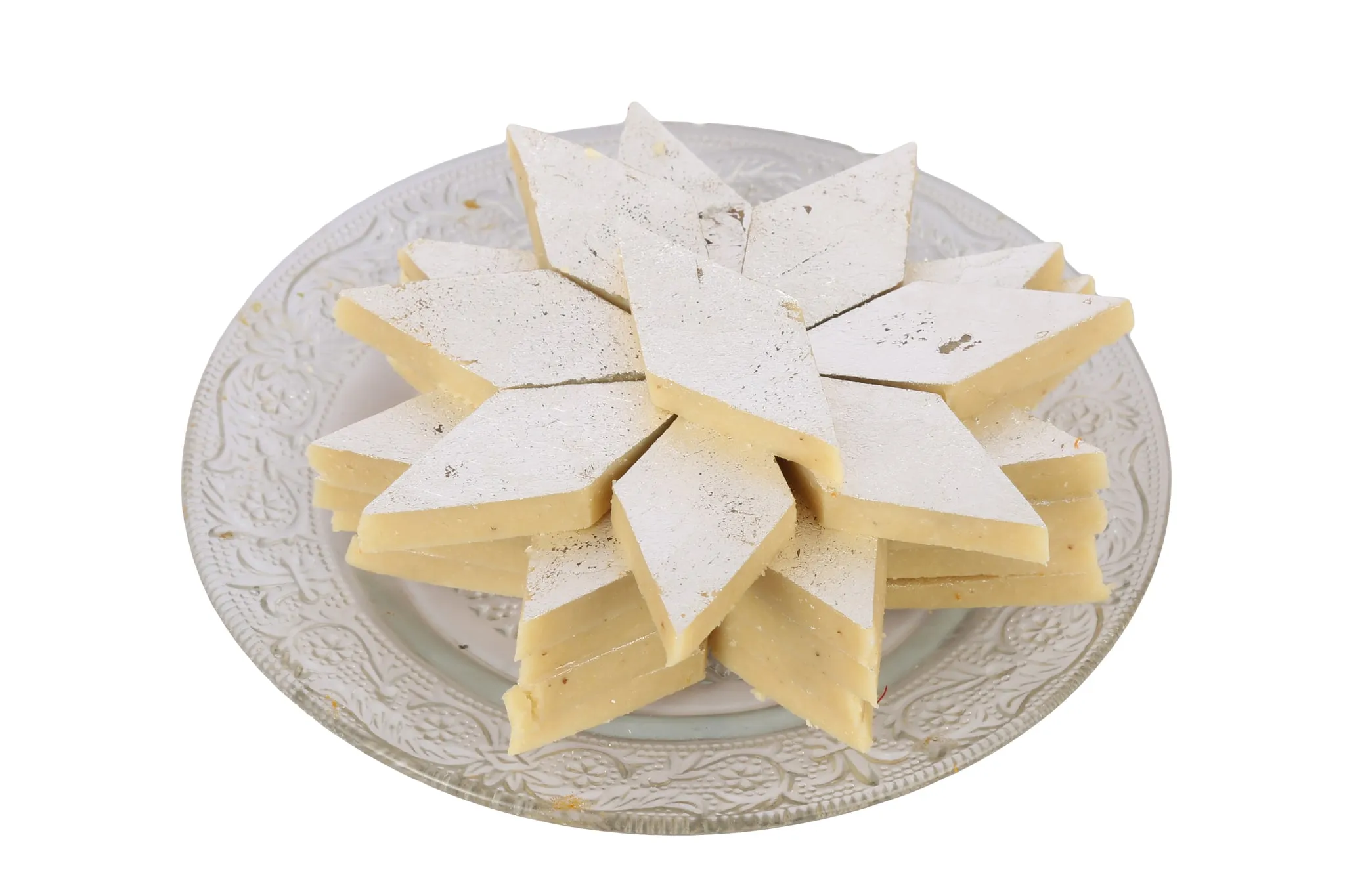
- Peel off the top parchment. If using silver leaf, lay the sheets over the surface now and press very gently with the parchment (never touch vark with bare or damp fingers — it will stick and tear). Let the slab sit uncovered at room temperature for 20-30 minutes until firm but not brittle, then cut into diamonds with a sharp knife, wiping the blade clean between cuts.
Ingredient guides: Khoya (Mawa)
Ingredient swaps for cooks abroad
- No spice grinder strong enough for a fine powder: pulse the cashews with 1-2 tbsp of the measured sugar to help them break down without turning oily, then proceed as normal.
- Can't find edible silver leaf (vark) locally: skip it entirely — the barfi tastes identical without it — or brush the top very lightly with a paste of milk and a pinch of edible silver luster dust as a visual stand-in for festival plates.
- Sugar syrup keeps turning grainy or crystallizing on the pan sides: add 1/4 tsp lemon juice to the syrup once it starts boiling; the acidity stops stray crystals from seeding the rest of the batch.
- Want a firmer, more classic mithai-shop texture: reduce the water in the syrup by 1 tablespoon so it's slightly more concentrated, which gives a denser, less fudgy bite closer to what you'd get from a sweet shop counter in India.
Frequently asked questions
- Do I have to use silver leaf?
- No. Silver leaf, called vark or chandi vark, is wafer-thin edible foil pressed onto sweets for festive presentation and it has no flavour at all. Skipping it changes nothing about how the barfi tastes or sets, only how it looks on a Diwali plate. One reason some families skip it: vark was traditionally beaten between layers of animal gut. India now bans that, but leaf sold abroad is not always labelled with how it was made, so for a vegetarian or vegan table, leave it off unless the packet says.
- How thin should I roll the dough?
- About 1/8 inch, or 3mm. Thinner than that and the pieces turn brittle and crack when you lift them; much thicker and it eats as a dense fudge rather than the delicate slice kaju katli is meant to be. Roll it while the dough is still warm, because it stiffens as it cools.
- Will a food processor grind cashews finely enough?
- A food processor tends to warm the nuts and turn them oily before they are fine enough, which gives a greasy, pasty barfi. A spice or coffee grinder in short 5-second pulses works far better. If a processor is all you have, pulse the cashews with a spoonful of the measured sugar to absorb the released oil.
- Does kaju katli keep well enough to make ahead of Diwali?
- Yes, and making it two or three days ahead is normal practice. Cut pieces keep about a week in an airtight container at room temperature, or two weeks refrigerated. Let chilled pieces sit out for fifteen minutes before serving so they soften back to the right texture.
- What is the difference between kaju katli and kaju barfi?
- Mostly the name. Both are cashews ground and cooked into sugar syrup, and many shops and families use the two names for the same sweet. Where people do draw a line, kaju katli is the thin version cut into diamonds, since katli means a slice, and kaju barfi is a thicker piece, often cut square. The recipe is the same; only the rolling thickness and the cut change.
More barfi & fudge
View all →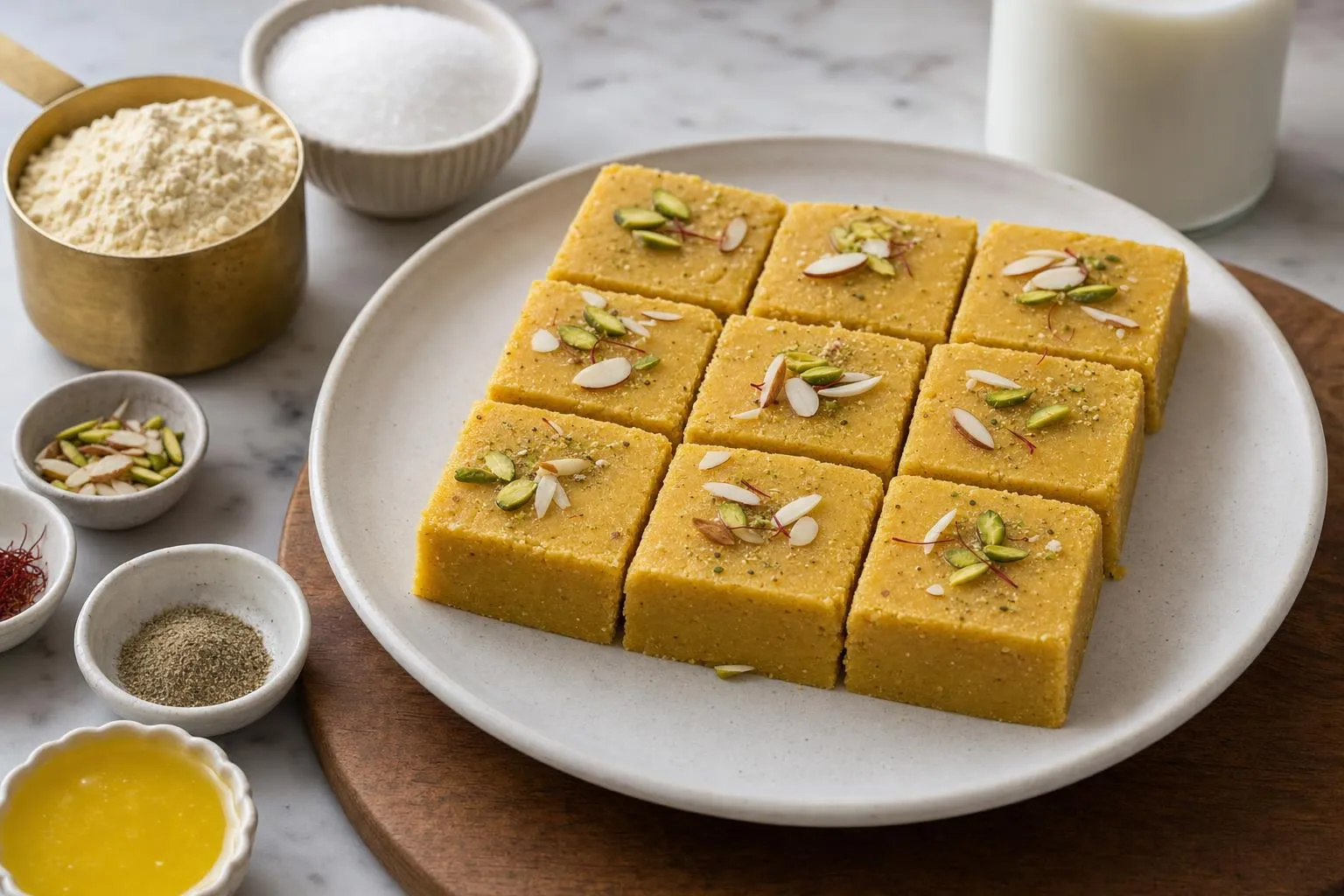 50 min
Besan Barfi (Fudgy Gram Flour Barfi)
A dense, fudgy besan barfi that depends on roasting the gram flour to a deep amber shade before it meets the sugar.
 55 min
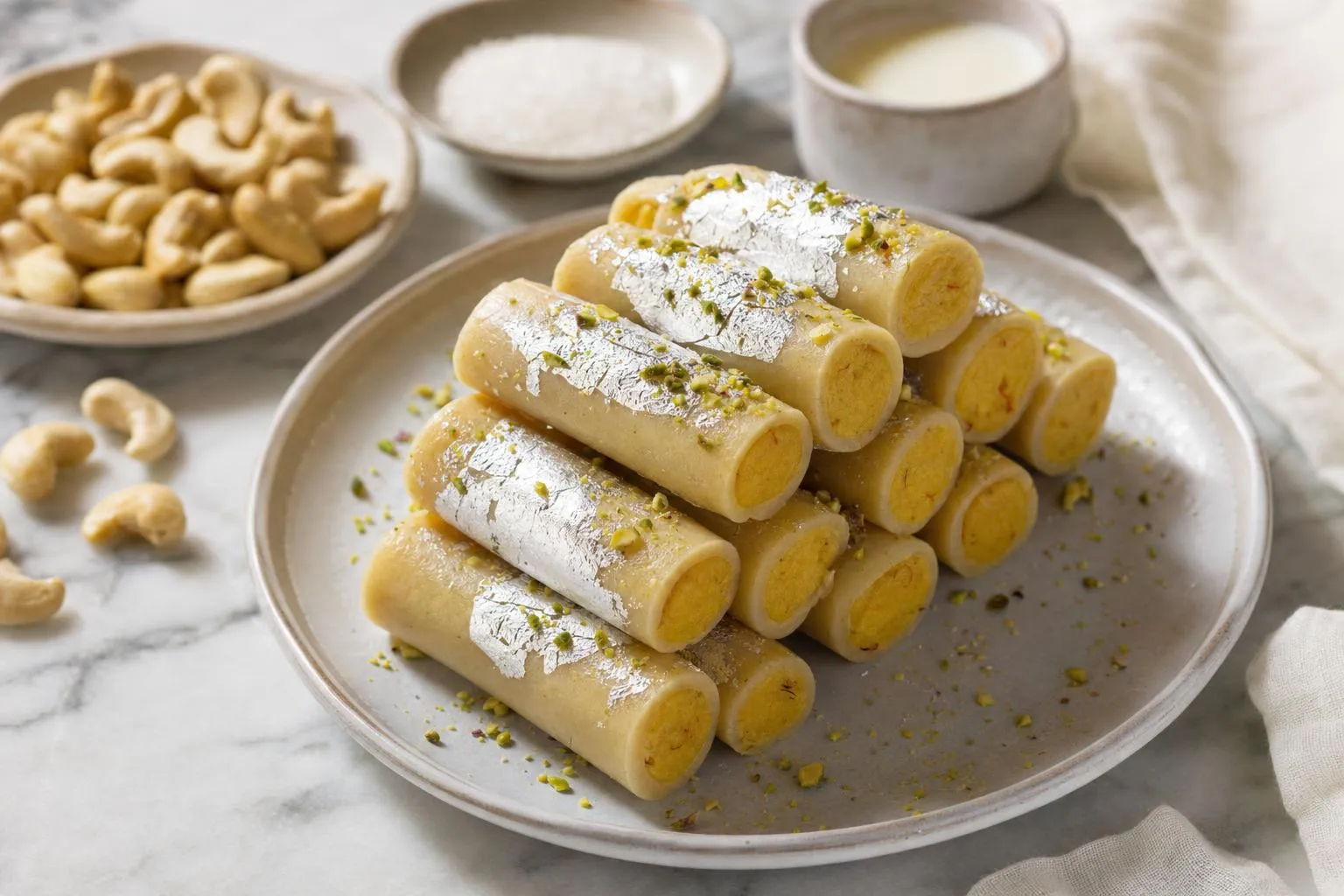
Kaju Roll (Cashew Rolls with Kesar Filling)
Thin sheets of cashew katli dough rolled around a saffron-cardamom filling, sliced into neat pinwheels.
 1 hr 5 min
Mohanthal (Gujarati Besan Barfi)
A grainy, ghee-rich Gujarati besan barfi, with the texture built in at the dhabo stage before roasting.