
Kaju Roll (Cashew Rolls with Kesar Filling)
Thin sheets of cashew katli dough rolled around a saffron-cardamom filling, sliced into neat pinwheels.
Kaju roll is cashew katli dough — ground cashews cooked into a smooth paste with sugar syrup — rolled thin, spread with a saffron and khoya filling, then rolled into a log and sliced into pinwheels. The whole thing works or fails on rolling the dough thin and pliable while it's still warm; let it cool and dry out first, and it will crack instead of curling into a spiral.
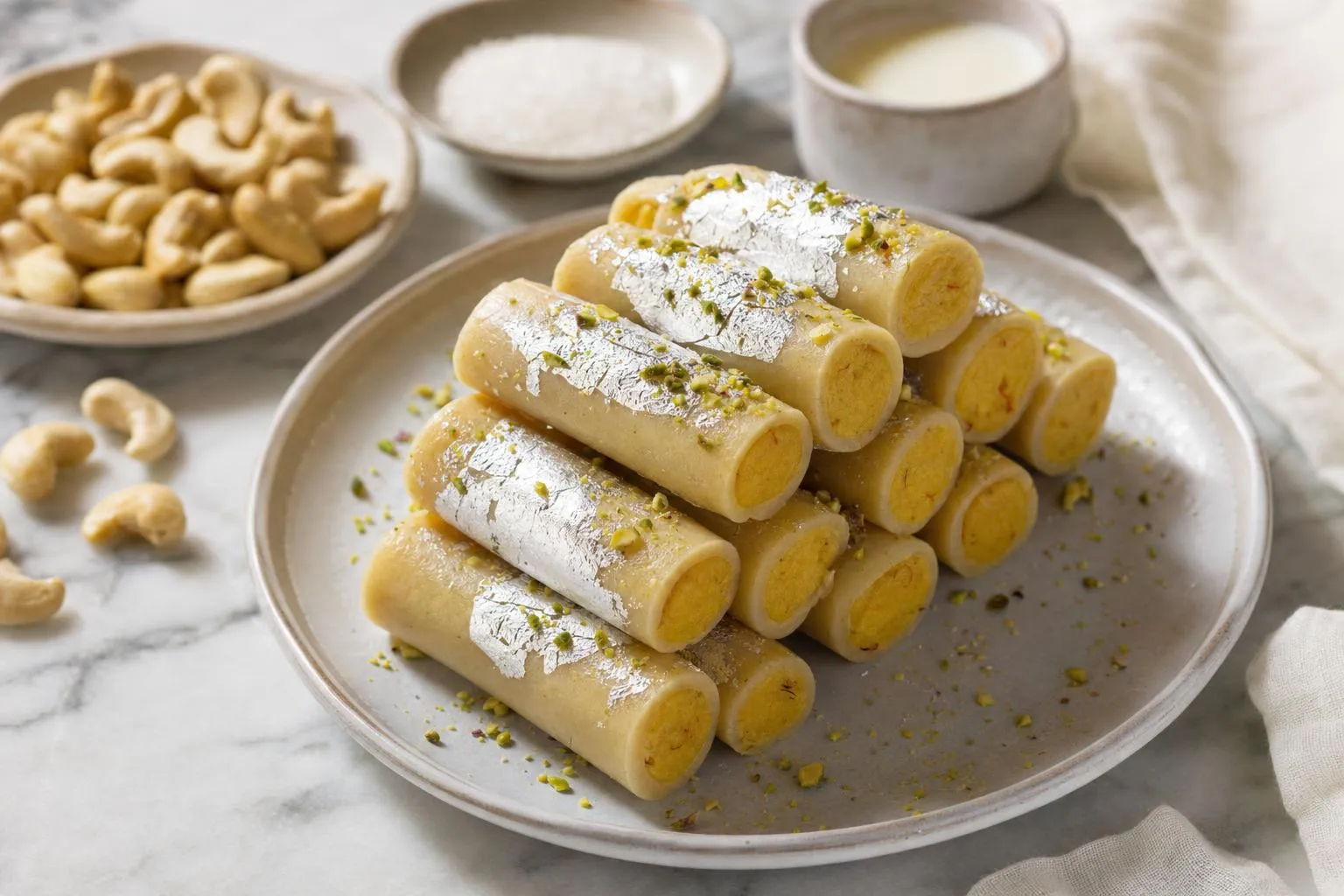
Kaju roll is kaju katli’s more ambitious cousin — same dough, but instead of cutting it into diamonds, you roll it thin, fill it, and coil it into a log that slices into neat spirals. Sweet shops sell these at a premium because the technique is fussier than it looks. Get the dough right and the rest is just patience.
The filling here is a simple khoya-kesar paste — khoya is dried, reduced whole milk, sold in Indian grocers as mawa — cooked just long enough to hold its shape without turning crumbly. Bloom the saffron in warm milk rather than mixing it in dry; warm milk pulls the colour and aroma out of the strands far better, and you’ll see the milk turn a deep amber within ten minutes. Skip that step and the filling looks pale and tastes mostly of sugar.
If you’ve made kaju katli before, the dough stage will feel familiar, right up until you have to roll it instead of pressing it flat in a tin. That’s the real skill here, and it’s also what separates a good dry fruit roll from a dry, cracked one — both rely on a pliable dough that hasn’t been allowed to cool and set before shaping. If this is your first time working with a kesar filling, the anjeer roll uses the same spiral technique with a fig paste, which is more forgiving while you get the rolling motion down.
Why this works
Cashew dough behaves like warm marzipan — pliable while hot, brittle once it cools and the sugar recrystallises. Rolling it thin while the heat is still in it lets the dough stretch instead of tear, which is exactly the window you need to spiral it around a filling without the edges splitting. Once it cools past that point, the dough holds shape but won’t bend; that’s fine for katli’s flat diamonds, wrong for a roll.
The khoya in the filling does double duty. It carries the saffron’s colour and smell evenly through the paste, and its fat content keeps the filling soft enough to slice cleanly days later, rather than drying into a hard core inside the roll.
Tips
- Grease your palms, rolling pin, and parchment with ghee, not oil — ghee won’t make the dough greasy or shiny in a way that shows on the cut surface.
- If the dough tears while rolling, it’s gone cold. Return it to the warm pan for 20-30 seconds over very low heat, knead briefly, and try again.
- Chill the rolled log before slicing. A knife through warm dough drags the filling and smears the spiral instead of cutting it clean.
Ingredients
Tap an ingredient to cross it off as you go.
Instructions
- Grind the cashews in short pulses to a fine, dry powder. Stop before the oils release — the mix should look like damp sand, not paste.
- Bring sugar and water to a one-string syrup: a drop between two fingers should form a single thin thread when you pull them apart, around 3-4 minutes of boiling.
- Turn the heat to low, tip in the cashew powder and milk powder, and stir fast and constant. The mixture will go from wet to a thick mass that pulls off the pan in under 2 minutes — pull it off right then, not later.
- Turn the dough onto a greased plate. Knead with greased palms while it's still warm, about 3-4 minutes, until smooth and crack-free like soft modelling clay. Cover and let it cool to room temperature, roughly 20 minutes.
- Bloom the saffron in the warm milk for 10 minutes until the milk turns deep amber. Mash the khoya smooth in a pan on low heat for a minute, then mix in the powdered sugar, cardamom, and the saffron milk. Cook 2-3 minutes until it clumps into a soft, rollable paste, then cool completely.
- Roll the cashew dough between two sheets of greased parchment into a rectangle about 1/8 inch (3mm) thick. Work quickly — if it dries and the edges start cracking, that's your cue to re-grease and keep moving.
- Peel off the top sheet. Spread the cooled kesar filling in a thin, even layer, leaving a bare half-inch border on one long edge to seal the roll.
- Using the parchment underneath to help you, roll the sheet into a tight log, starting from the filled edge. Press the seam gently to close it, then wrap and chill the log for 20 minutes to firm up.
- Unwrap, press on silver leaf if using, and slice into 1/2-inch rounds with a sharp, slightly wet knife. Press a pinch of chopped pistachio onto each cut face.
Ingredient swaps for cooks abroad
- No khoya available: simmer 1 cup whole milk powder with 2 tbsp milk and 1 tsp ghee on low heat for 3-4 minutes, stirring until it masses up, and use that in place of khoya.
- Saffron substitute: a few drops of kewra water plus a tiny pinch of turmeric for colour will get you close, though the aroma won't be the same.
- No silver leaf: a light dusting of edible gold or silver lustre powder gives a similar shop-finish shine.
- Milk powder brands: any full-fat instant milk powder works — Nido, Anik, and Marigold are the ones most diaspora cooks already have in the pantry.
Frequently asked questions
- How thin should I roll the kaju dough for this to spiral properly?
- Aim for about 1/8 inch (3mm) — roughly the thickness of a thick coin. Thinner than that and the dough tears when you try to roll it; thicker and the spiral looks clunky with too much cashew and not enough filling in each slice.
- My roll cracked down the middle when I tried to coil it — what went wrong?
- This almost always means the dough cooled and dried before you finished rolling and filling it. Work on a warm surface, keep a damp cloth over any dough you're not actively handling, and if cracks appear, warm the sheet gently and smooth them with a greased fingertip before continuing.
- Can I make the roll ahead for a festival or party?
- Yes — the sliced rolls keep well in an airtight container in the fridge for up to a week. Bring them to room temperature for about 20 minutes before serving so the texture softens back to that slightly fudgy bite.
- What should the khoya filling look like when it's ready to spread?
- It should clump together into a soft, slightly glossy mass that holds its shape on a spoon but still spreads easily with the back of it — think thick frosting, not dry crumbs. If it's crumbly, you've cooked it too long; add a teaspoon of warm milk and stir it back together off the heat.
- Is there a way to scale this up for a bigger batch of mithai boxes?
- Doubling the recipe works fine, but roll the dough in two separate batches rather than one giant sheet — a large sheet cools unevenly before you've finished rolling it, and the edges will crack while the centre is still workable.
More barfi & fudge
View all →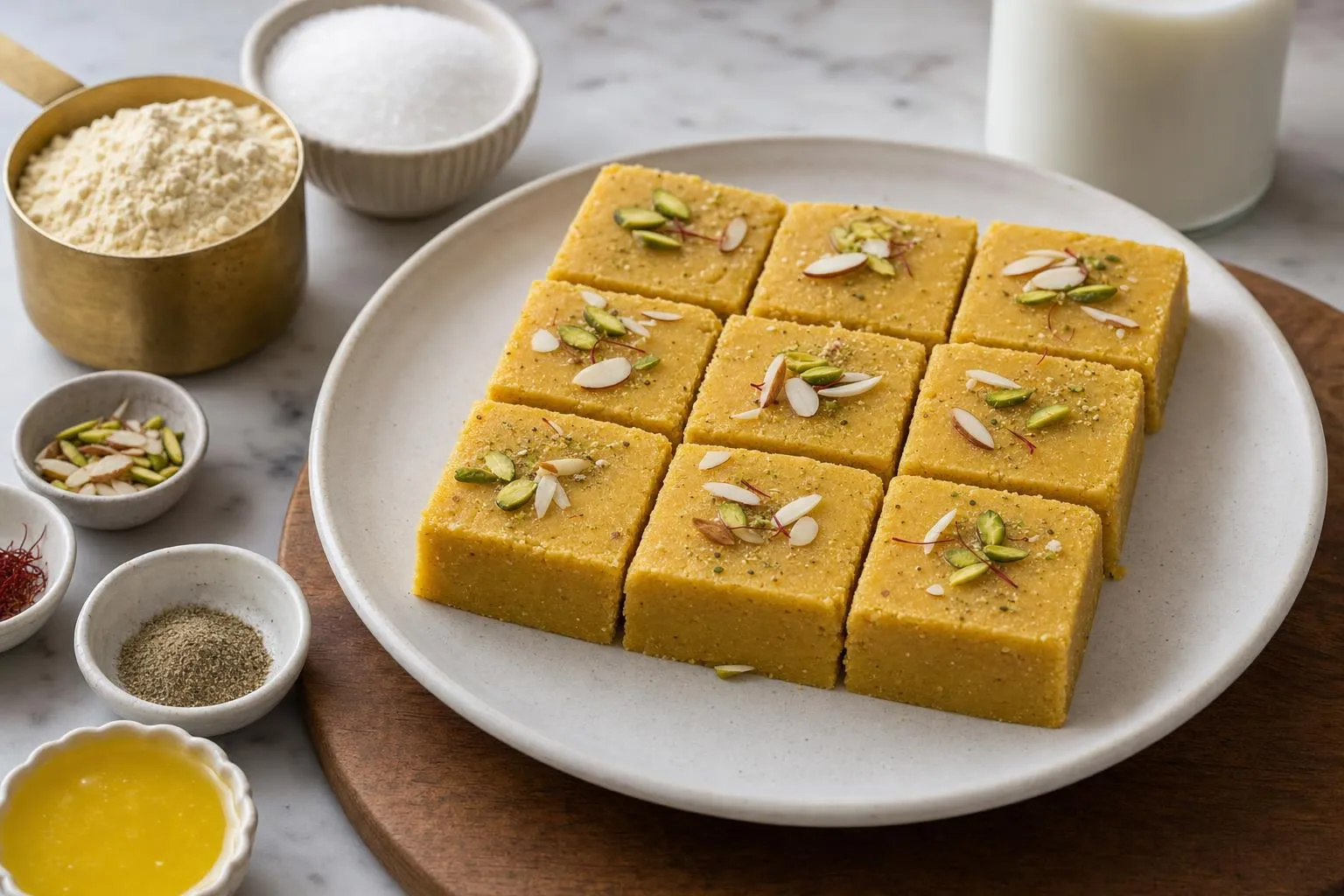 50 min
Besan Barfi (Fudgy Gram Flour Barfi)
A dense, fudgy besan barfi that depends on roasting the gram flour to a deep amber shade before it meets the sugar.
 45 min
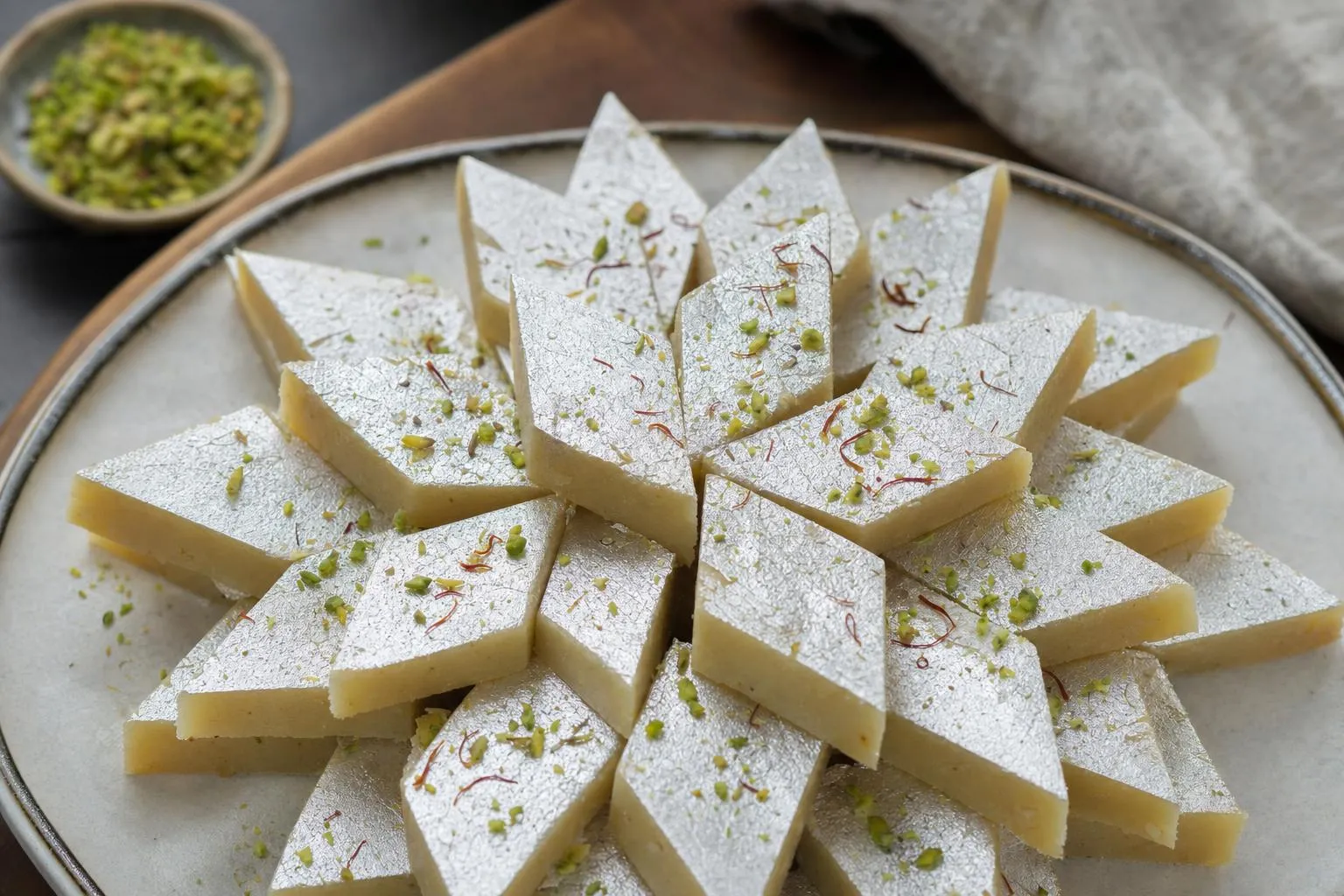
Kaju Katli (Cashew Barfi) Without a Candy Thermometer
Thin, diamond-cut cashew fudge made with just cashews and sugar syrup, cooked to the classic one-string stage by eye and feel.
 1 hr 5 min
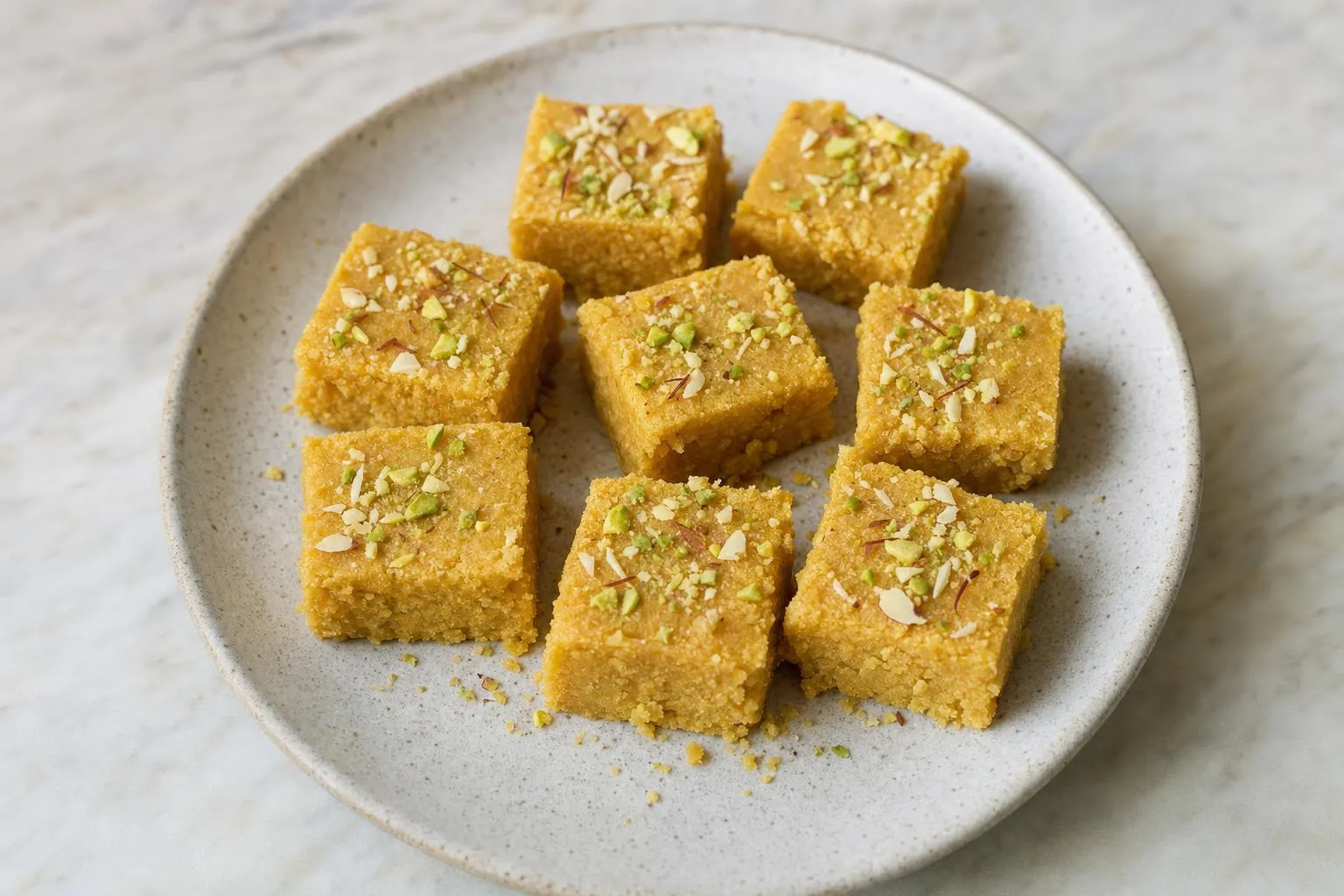
Mohanthal (Gujarati Besan Barfi)
A grainy, ghee-rich Gujarati besan barfi, with the texture built in at the dhabo stage before roasting.